

Email Is Not Dead, but Your Sequence Might Be
Sequences rarely fail because email stopped working. They fail because they talk about the sender, fire on a calendar instead of a signal, and ask for five things in one message.
On This Page
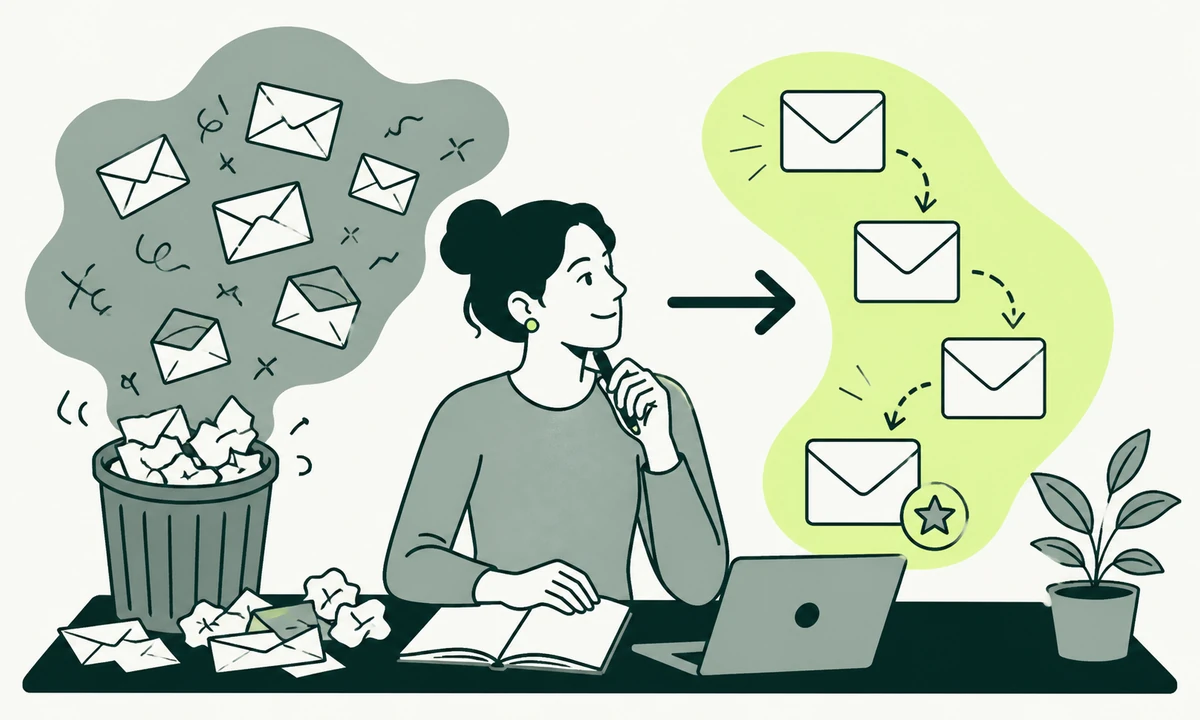
Open the last sequence you sent and count the sentences that describe you: your platform, your founding story, your release notes, your webinar. Then count the sentences that describe a situation the reader is actually in. If the first number is larger, the sequence is not underperforming because email is tired. It is underperforming because it is about the wrong subject.
An email marketing sequence fails in four places, and send volume is usually the last of them. The trigger is wrong, so the first message arrives at a moment that means nothing. The cadence is set by a calendar rather than by behaviour. Each email asks for several things at once and therefore achieves none. And the unsubscribe is treated as a leak to be plugged rather than the clearest quality signal available in the channel.
The position we will defend: send fewer emails, timed to something the reader did, each carrying one purpose. That is not the timid version of the strategy. It is the version that survives contact with an inbox that was already full before you arrived.
The sequence that talks about the sender
Read your own sequence end to end as a transcript of a conversation, out loud if you can stand it. Most of them sound like someone at a party describing their company to a person who asked what time it was. Every sentence is defensible in isolation. Together they are a monologue.
This happens for an unremarkable reason. Sequences are written by the people who know the product best, in the order the product makes sense to them, and reviewed by people with the same knowledge. Nobody in the approval chain has the reader’s ignorance, so nobody notices that email two assumes a decision the reader has not made.
- The subject line names you. Your product, your event, your announcement. Nothing in it belongs to the reader, so nothing in it competes with the forty other lines on the screen.
- The first paragraph is context you needed to write. Background that made the email easier to compose, and made it slower to read. Cut it and start at the second paragraph, which is usually the real one.
- The call to action assumes a decision already made. "Book a demo" in the first message asks somebody who has not yet agreed that they have the problem your demo solves.
The rewrite that fixes most of it
Take each email and answer one question in a single line: what does the reader now know, have, or find easier that they did not before opening this? If the honest answer is "that we exist" or "that we released something", it is a company update rather than an email, and company updates belong somewhere a person chose to look.
Trigger design: what actually starts a sequence
A trigger is a claim about intent, and most sequences use one claim for every situation. Downloading a guide claims interest in a subject. Starting a trial claims interest in the product. Visiting the pricing page twice in a week claims a live evaluation, possibly with someone else asking for a number. Those are three different people, and sending all three the same first email wastes the only moment when you reliably have their attention.
Getting that right is less a copywriting problem than a systems one: the sequence has to read the signal correctly before it can say anything sensible, which is the argument in marketing automation that behaves like a person would.
| Trigger | What it claims | A reasonable first message | What kills it |
|---|---|---|---|
| Guide downloaded | Interest in a subject | The next question that guide raises | A demo request |
| Pricing visited repeatedly | An evaluation in progress | A short offer to answer one specific question | A newsletter signup |
| Trial started | Interest in the product itself | One step that produces a first visible result | A full feature tour |
| Trial gone quiet | Something blocked them | One question, answerable in a single line | A discount |
| Enquiry submitted | A live, dated request | A reply from a person, the same day | An automated nurture track |
Time-based and behaviour-based, and when each is right
Time-based sequences are easier to build, easier to report on, and easier to ignore, because day three has no meaning to the recipient. Behaviour-based sequences are harder to build and land better, because the message arrives attached to something the person remembers doing. The trade is real: behavioural triggers need instrumentation somebody has to maintain, which is one of the standing costs of any marketing automation setup and one of the first things to rot when the person who built it moves on.
The other constraint is that most sites collect exactly one signal: a form submission. That is a thin basis for personalisation. A lightweight widget that answers questions from the site’s own content and carries contact and conversion actions, such as Flidu, produces a richer signal than a form alone, because what somebody asked in their own words is a better trigger than which of your five dropdown options they tolerated.
Cadence: the case for fewer, better-timed sends
The default cadence in most tools is every three days for five emails, because that is what the template offered when somebody clicked create. Nobody chose it. Nobody has revisited it. It persists because changing it requires an argument and leaving it does not.
We would rather send three messages across a month, each attached to something that happened, than seven across a fortnight attached to a countdown. The reason is not politeness. It is that attention compounds in both directions: mailbox providers weigh how recipients treat your mail, so a list trained to ignore you is expensive to untrain, and the cost lands on the message you actually needed to get through.
How many messages a decision needs is a separate question from how quickly they should arrive, and conflating the two is why sequences get compressed rather than shortened. We have looked at the first question in how many touches a B2B buyer needs before replying. The short version, for cadence purposes: the number of useful contacts is larger than most teams expect and the acceptable rate is slower than most tools default to.
Put every email in the sequence into one document, in order, with the delay between each written above it. Read it as a single conversation. If the same point appears twice, or a message arrives with nothing new to say because the calendar demanded it, you have found the send to cut. This takes twenty minutes and finds more than most reporting dashboards will.
One email, one purpose
Most underperforming emails ask for three things. Read the article, follow the company, book a call. Each request was added by a different person for a defensible reason, and the combined effect is a reader who does nothing, because choosing between three options takes more effort than closing the tab.
The rule is one purpose, one action, one link that matters. Secondary links are allowed when they are genuinely secondary and look it. A purpose can be small: answer a question, hand over a thing, ask something that gets a reply, move one decision forward by one step. Small is fine. Plural is not.
What happens after the click is part of the email
An email with one clear purpose landing on a page with four competing ones has not solved anything; it has relocated the problem. The destination page should continue the sentence the email started, using the same words, which is a small piece of conversion work that costs nothing and is skipped constantly. It is also one of the quieter reasons a redesign converts worse than the page it replaced: the campaigns pointing at it were written against the old wording.
And whatever the design, the message has to be readable. Sufficient contrast, a sensible heading order, alternative text that carries meaning rather than repeating the file name, and a body that still makes sense when images are blocked. The standards you hold the website to apply in the inbox as well, and the inbox is harsher, because a good share of it is read in a narrow preview pane with images off.
The unsubscribe is a quality signal, not a leak
Teams hide the unsubscribe link, and the instinct is wrong on every axis. Legally, under the regulation governing consent in the EU, withdrawing consent has to be as easy as giving it. Practically, a person who wants out and cannot find the link marks the message as spam instead, and that costs far more than the address ever did.
Read unsubscribes as feedback with a timestamp attached. A cluster after one particular email tells you that email was wrong, and which one, without any survey. A steady trickle spread evenly across a sequence usually means the promise made at signup does not match what is being sent. Both are more useful than an open rate, because somebody took an action to tell you something.
Offer less rather than nothing. A preference choice, honestly presented, keeps people who would otherwise leave outright, and it turns an irreversible decision into an adjustable one. That is the same principle behind retargeting without following people around: the restrained version usually outlasts the aggressive one.
A contact who has not opened or clicked in a long time is not a lead held in reserve. It is a drag on how the rest of your mail is treated. Send one message offering three options: stay, receive less, or leave. Then honour the answer, and treat silence as the third one.
Fixing a sequence you already have
You do not need to start again. Most sequences contain two good emails buried in six mediocre ones, and the work is subtraction before it is writing.
- Print the whole thing. Every email, in order, as one document. Most sequences have never been read end to end by a single person, which is exactly how they drift.
- Mark every sentence whose subject is you. Highlighter, literally. The pattern on the page tells you more in a minute than a month of reporting.
- Name each email’s purpose in five words. Any email you cannot name gets cut rather than rewritten. Rewriting an email with no purpose produces a better email with no purpose.
- Check the trigger against the first line. If the opening sentence would read identically for someone who did something entirely different, the trigger is decorative.
- Halve the cadence and re-time what survives. Attach each remaining send to a behaviour where one exists, and to a genuinely useful interval where none does.
- Rewrite the first email last. It is the hardest one and it should inherit everything the other edits taught you about what the reader actually wants.
Expect the result to be shorter. That is the point, not a side effect. The discipline that keeps this from re-inflating is the same one that keeps a content calendar alive through a busy quarter: a standing slot to review what exists, rather than a standing target for how much to produce.
Measuring, now that opens stopped being honest
Open rates lost most of their meaning when mail clients began fetching images on the recipient’s behalf, which registers as an open nobody performed. Some teams still report them because the number is large and moves reassuringly. It is a comfort metric.
Measure replies, clicks to a page that matters, and the action that follows: a booking, a signup, an actual human answering. Then judge at the sequence level across a window long enough to mean something, which is the argument in what ninety days can honestly show. Per-email metrics are useful for deciding which send to cut and close to useless for deciding whether the programme works.
Remember also that the sequence is one surface among several. The same person may be reading an article you published, seeing an advertisement, and receiving your mail in the same week, and attribution will hand the credit to whichever one happened to be last. A cluster of articles that answers their questions often does the persuading that the email gets credited for, and designing them as one programme is the job of lifecycle marketing rather than of any single channel owner.
Where this advice reverses
Everything above applies to persuasion mail. It does not apply to transactional and operational messages, where the opposite is true. Order confirmations, dispatch notices, password resets, renewal warnings and failed-payment alerts should be immediate, frequent and completely unapologetic. Nobody has ever complained that a delivery notification arrived too promptly. Trying to be restrained in that category is how people miss a renewal and blame you for it.
A genuine deadline also earns a calendar cadence. An event that closes on a date, a plan that expires, a place that will be given away: those legitimately justify a reminder rhythm, because the calendar is real for the reader too rather than only for you. The failure is borrowing that urgency for something with no deadline in it, which readers detect immediately and remember longer than you would like.
An email earns its send when you can name the reader’s situation, the one thing this message gives them, and what changed to make today the right day.
Miss any of those three and the send becomes a tax on the next one you genuinely need to get through, which is the real cost of a tired sequence and the reason volume is the wrong lever. Start with the printout. If yours has never been read end to end by one person, that alone will explain more than any report, and if you want another set of eyes on what it triggers on, tell us what it currently sends and when.
Common questions.
How many emails should a nurture sequence contain?
Fewer than most templates suggest, and the number depends on how many genuine steps exist between the trigger and the decision you want. If you cannot name each email’s purpose in five words, the sequence is too long. Three messages attached to real behaviour usually outperform seven attached to a countdown, because each arrival is connected to something the recipient remembers doing.
Why are my open rates high but nothing happens afterwards?
Open rates became unreliable once mail clients started fetching images on the recipient’s behalf, which records opens nobody performed. Treat the figure as a comfort metric and judge the sequence on replies, clicks to pages that matter, and the action that follows such as a booking or signup. If those are flat while opens look healthy, the subject lines are working and the content is not.
Should I remove subscribers who never open my emails?
Yes, after offering a choice first. Send one message asking whether they want to stay, receive less, or leave, then act on the answer and treat silence as a decision to leave. Inactive addresses do not sit harmlessly on a list: mailbox providers weigh how recipients treat your mail, so a large unengaged segment affects whether your important messages reach the people who do want them.
What makes a good email trigger?
A good trigger is a specific action that implies something about intent and that the recipient will remember taking. Downloading a particular guide, visiting pricing more than once, starting a trial, or going quiet mid-trial all qualify. Weak triggers are ones the reader cannot recall or that would produce the same message for entirely different people, such as joining a list without any further context.
Is it better to send one long email or several short ones?
Several short ones, provided each has a distinct purpose and something new to say. A long email tends to contain several requests, and multiple requests in one message reliably produce no action at all. Splitting only helps when the parts are genuinely separate; slicing one idea across four sends to fill a schedule produces four messages that each feel incomplete.
How often should we review an existing email sequence?
At least once a quarter, and always after a change to the pages it links to. Print every message in order with the delays between them and read the result as one conversation. Sequences drift because individual emails get edited in isolation and nobody reads the whole thing, so the review needs a scheduled slot rather than a good intention.
Facing this in your
own business?
Tell us where you’re headed — we’ll map the shortest honest route.