

Attribution You Can Defend When the Board Asks Where Leads Came From
Last click and first click are both wrong, and multi-touch models are assumptions in a lab coat. A marketing attribution practice that survives a board meeting: self-reported source, channel trend and holdouts.
On This Page
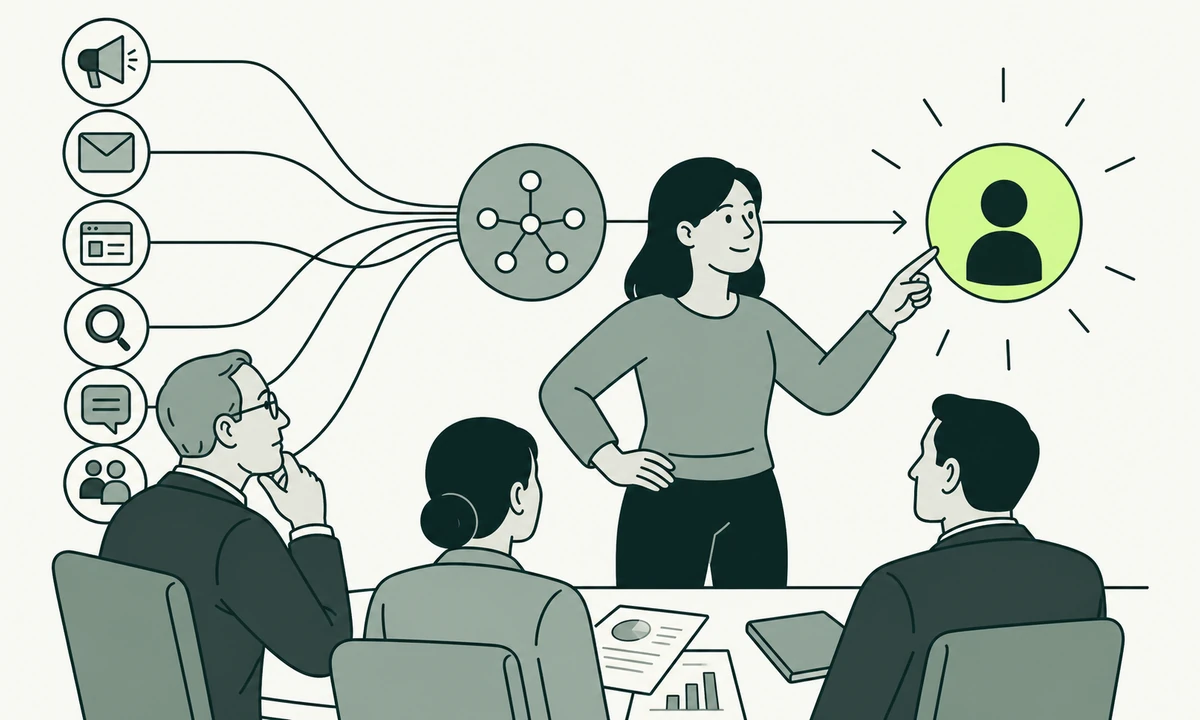
Someone at the far end of the table asks where the leads came from, and the room hears a request for a report. It is not one. It is a request for permission to cut something, and everybody in the meeting already knows which line they have in mind. That is a decision question, and decision questions tolerate uncertainty far better than reporting questions do.
Which is why the standard response fails. A pie chart splitting credit across six channels looks like an answer, survives about ninety seconds of questioning, and then collapses the moment somebody asks how the model decided. The position this piece defends is that no marketing attribution model measures causation, that saying so out loud costs you nothing, and that there is a practice underneath it which does hold up.
The short version: ask buyers directly, watch channels at the level of trend, and prove the rest with holdouts. Three instruments, none of them precise, all of them defensible. Everything else is arithmetic performed on data with holes in it.
What the board is actually asking
Nobody wants a credit allocation. They want to know which spending is doing work, which is coasting on work done elsewhere, and what happens to next quarter if a line disappears. Read the question that way and the reporting problem changes shape entirely, because you no longer need to know what every touch contributed. You need to know what would break.
It also explains why the most commonly presented numbers are the least useful ones. Cost per lead by channel is easy to produce and quietly misleading, for reasons worth reading separately in why cost per lead is a trap. A channel producing cheap leads that never renew is not cheap. A channel producing four expensive leads a quarter, three of which close, is not expensive. Attribution arguments are frequently unit-of-measure arguments in disguise.
There is an organisational reading of this too, and pretending otherwise makes the meeting harder than it needs to be. Whoever owns the channel the model credits owns the budget next year. That means an attribution debate is rarely only a methods debate, and a method chosen because it flatters one team will be attacked by another for exactly that reason. Choosing a method everyone agrees is imperfect, in advance, removes most of the argument before it starts.
Last click and first click are both wrong
Last-click attribution credits whatever happened immediately before the form submission. In practice that is nearly always the channel a buyer uses to come back once they have already decided: a branded search, a direct visit, a retargeting ad shown to somebody who was going to convert regardless. It rewards the closer and starves the introducer, systematically, in the same direction, every single month.
First click carries the mirror-image bias. It hands everything to discovery and nothing to whatever turned mild interest into a signed contract. It also depends on having observed the genuine first visit, which assumes an identifier that survived months of browsers, devices and consent choices. For most businesses that assumption is untrue, and the "first" click on record is simply the earliest one that happened to be captured.
Why last click survives anyway
Because it is the only model that requires no assumptions. Last click is a fact about your data rather than an inference from it, and that is a genuine virtue nobody gives it credit for. The failure is in the reading. Last click describes where the conversion was recorded, and gets read as where the conversion came from. Keep it in the reporting as a record of events, label it as one, and stop asking it to justify a budget.
Why marketing attribution models are assumptions in a lab coat
Multi-touch models fix the obvious problem by spreading credit across the recorded path. Linear splits it evenly. Time decay gives more to recent touches. Position-based weights the two ends. Data-driven models derive their weights from patterns across converting and non-converting paths, which is a real improvement, and still an inference drawn from an incomplete record.
Here is the part no amount of modelling escapes. Every one of these describes correlation across touches you happened to observe. None of them can tell you what would have happened if a touch had not occurred, because that outcome was never recorded anywhere. Only an experiment produces it, and a model wearing enough decimal places is very good at hiding the fact that it is not one.
| Model | What it assumes | Where it misleads |
|---|---|---|
| Last click | The final recorded touch caused the sale | Over-credits branded search, direct and retargeting |
| First click | Discovery deserves the credit | Assumes you observed a first visit you probably did not |
| Linear | Every touch mattered equally | Flatters high-frequency, low-influence channels |
| Time decay | Recency equals influence | An assumption about memory, not a measurement of it |
| Position-based | The two ends matter most | Arbitrary weights defended as a convention |
| Data-driven | Observed paths represent all paths | Inherits every consent, device and offline gap |
| All of them | The recorded path is the whole journey | Cannot see conversations, referrals or an answer with no click |
None of which makes the models useless. A data-driven model is a perfectly reasonable way to notice that one channel keeps appearing early in successful paths and almost never appears last, and that observation is worth having. The mistake is promotion: treating a description of observed patterns as a measurement of contribution, then dividing a budget by it. Use these models to generate hypotheses. Do not use them to settle arguments.
Write down what you cannot know
Put this list on the same slide as the numbers. It reads as an admission of weakness for roughly one meeting, and then it becomes the reason people believe the rest of what you say.
- Which touch changed the mind. Nobody knows this, including the buyer, who reconstructs a tidy story afterwards the way everyone else does.
- What would have happened without a channel. The counterfactual is unobservable by definition. It can only be estimated by deliberately removing something and watching.
- Who else was involved. In considered purchases several people research separately, one of them fills in the form, and only that person leaves a trail.
- Everything that happened in conversation. A recommendation in a private group, a mention at an event, a former colleague. None of it is instrumented and all of it converts.
- The visits you never saw. Consent choices, browser restrictions and blocked scripts remove sessions from the record entirely. Lawful collection and complete collection are different projects.
That last category is growing rather than shrinking. Assistants increasingly answer a question outright, so research that used to arrive as a measurable session now happens where you cannot see it, which is one reason being quoted in AI answers produces influence that surfaces later under a different label, usually as direct traffic or a branded search.
Three instruments that survive scrutiny
None of these is precise. Used together they are defensible, which is a different and more useful property, because a defensible answer keeps working while somebody hostile examines it.
Ask the buyer, in their words
Self-reported attribution is one question on the enquiry form or in the first minute of the first call: how did you first hear about us? It reaches the parts analytics cannot, because a person can tell you about a podcast, a colleague, or an answer they read three weeks ago on a device you never saw.
Use an open field rather than a dropdown. A dropdown teaches people the answer, and every option you list gets chosen more often than it deserves. Code the free-text responses into a small fixed set once a week, and keep the raw wording, because the raw wording is where the useful surprises are. Where the form itself is the constraint, that is ordinary conversion work rather than a measurement problem.
"How did you first hear about us" and "what made you get in touch today" measure different things, and teams routinely ask one while reporting the other. Ask the first if you are budgeting for awareness, the second if you are judging campaigns. Keep the field optional, keep it short, and never make it a required dropdown.
Watch channels at the level of trend
Stop attributing individual deals. Track each channel as a shape over time, against what you spent and against qualified pipeline rather than raw enquiries, then look for coincidence and lag. It is coarse, and it catches what matters: the channel that flattened when the budget doubled, which is the pattern behind paid search failing to scale, or the channel that looks dead in the report while the real fault sits in the messaging, as it often does when the sequence rather than the medium is exhausted.
Prove the rest with holdouts
A holdout is the only causal instrument most teams can actually afford. Turn something off, or withhold it from one region or segment, long enough for an effect to appear, then compare what happens against both the period before and the population you left alone. It answers the counterfactual question directly, which no model can.
- Isolate one thing. One channel, in one geography or segment you can separate cleanly. Two variables at once produces a result nobody in the room will accept.
- Write the prediction down first. State what you expect to happen and how large a movement would count as an effect. Deciding that afterwards is how teams talk themselves into noise.
- Set the window by the sales cycle. Long enough for a buyer to move from first contact to decision, not the length your patience supports.
- Change nothing else. No new offer, no site redesign, no pricing change mid-window. Every additional change costs you the ability to read the result.
- Read both comparisons together. Against the prior period and against the untouched group. Agreement between the two is what makes a finding survive a hostile question.
Holdouts take nerve, because you are deliberately spending less in order to learn something, and they take time. Our parent company has written about the honest limits of a short measurement window in what ninety days can honestly show, which is worth reading before promising a board a conclusion by the next meeting.
The slide you actually bring
Three blocks, in this order. What we spent, by channel, without commentary. What moved, meaning pipeline and closed business plotted against that spend over enough months to have a shape. What we believe and why, written in sentences, each one carrying the evidence behind it and a plain statement of how confident we are.
A number with a stated confidence is worth more to a board than a number with a decimal place.
The habit worth borrowing comes from audit work, where every finding carries a severity, a recommendation and a named level of confidence, and somebody reviews it before it leaves the building. Reporting tools built to that shape, such as Prooflin, resolve findings and recommendations into a reviewable report rather than a dashboard, and the discipline transfers cleanly. Most attribution decks fail because they present conclusions with no attached confidence at all, which invites the reader to assume certainty and then feel misled.
What does not belong on the slide is a pie chart of fractional credit. It is the most confidently wrong object in marketing reporting, and building the reporting layer so that it never produces one is part of what strategy and analytics work is for.
Where this practice breaks
It breaks at low volume. A handful of enquiries a month gives self-reported answers no weight, and makes a holdout unreadable because ordinary variation swamps any effect you were hoping to see. It breaks with very long sales cycles, where a change made now surfaces well beyond the reporting period and everyone has moved on. It breaks entirely for a business with one channel, because there is nothing to compare against.
In those cases the honest substitute is qualitative and unfashionable: interview recent buyers properly, keep structured win and loss notes, and present a narrative supported by named evidence instead of a model. It is less impressive on a slide and considerably harder to argue with, because every claim traces back to a person who said something.
One more caveat, and it is the one we meet most often. Attribution regularly takes the blame for a problem that is not a measurement problem at all. When every channel underperforms at once the fault is usually upstream, in what is being offered rather than where it is being shown, which is the argument in the offer is the campaign. No attribution model has ever rescued a proposition nobody wanted.
What we would do in the first month
Add the question to the enquiry form this week. It is an afternoon of work, it starts accumulating immediately, and every week of delay is a week of answers you cannot recover later. Then rebuild the channel report around trend and qualified pipeline rather than cost per lead, and keep last click visible but labelled honestly as a record of events.
Do not run your first experiment on the channel you depend on most. Run it on the second or third, where being wrong is survivable, and use it to establish that the team can hold a window steady and read a result. Credibility with a board is built on a small finding that held up, not a large one that was contested.
Then schedule one holdout a quarter and treat the calendar as the deliverable. Four honest experiments a year will tell you more about which spending is load-bearing than any model applied to the same data, and the compounding effect is that the board stops asking for the pie chart, because it has started getting answers to the question it was actually asking. If you want help designing the first one, or a second look at how your paid channels are being credited, tell us what your reporting currently claims.
Common questions.
What is self-reported attribution?
Self-reported attribution means asking buyers directly how they first heard about you, usually as one open question on the enquiry form or early in the first call. It captures sources analytics cannot see, including conversations, recommendations and research done on devices you never observed. Use a free-text field rather than a dropdown, because listing options makes people pick from your list instead of remembering.
Is last-click attribution ever useful?
Yes, as a record of events rather than a measure of influence. Last click has one real advantage: it makes no assumptions, because it reports something that genuinely happened in your data. Keep it visible and label it accurately. The mistake is reading it as causal, which systematically over-credits branded search, direct visits and retargeting while starving the channels that created the demand.
What is a marketing holdout test?
A holdout test withholds one channel from a region, segment or audience for a set period, then compares results against both the preceding period and the group that kept receiving it. It is the practical way to estimate what a channel actually causes, because the comparison group approximates what would have happened without it. It needs enough volume for effects to show above normal variation.
Why do attribution reports disagree with the sales team?
Because they measure different things. Attribution reports describe recorded digital touches, while the sales team hears the reasons buyers give out loud, including referrals, events and conversations that leave no trail. Neither view is complete. Reconciling them means collecting self-reported sources systematically rather than anecdotally, then treating persistent disagreement as evidence of an untracked channel.
How long should a channel experiment run?
Long enough for a typical buyer to move from first contact to decision, which means the sales cycle sets the window rather than the reporting calendar. Shorter windows mostly measure noise. Decide the length before starting, along with what size of movement counts as a real effect, and resist the urge to stop early when the first numbers look encouraging.
Can consent rules and privacy settings break marketing measurement?
They limit it substantially, and that is a legal requirement rather than a technical fault. Declined consent, browser restrictions and blocked scripts remove sessions from the record entirely, so the measured population is a subset of the real one. Plan for measurement that works on partial data, using self-reported sources and channel-level experiments rather than models that assume a complete path.
Facing this in your
own business?
Tell us where you’re headed — we’ll map the shortest honest route.