

Why Does Paid Search Stop Working When You Scale the Budget?
Doubling the budget does not double demand. It buys the next impression down the list, and the account gets blamed for a ceiling that was set by the offer and the landing page.
On This Page
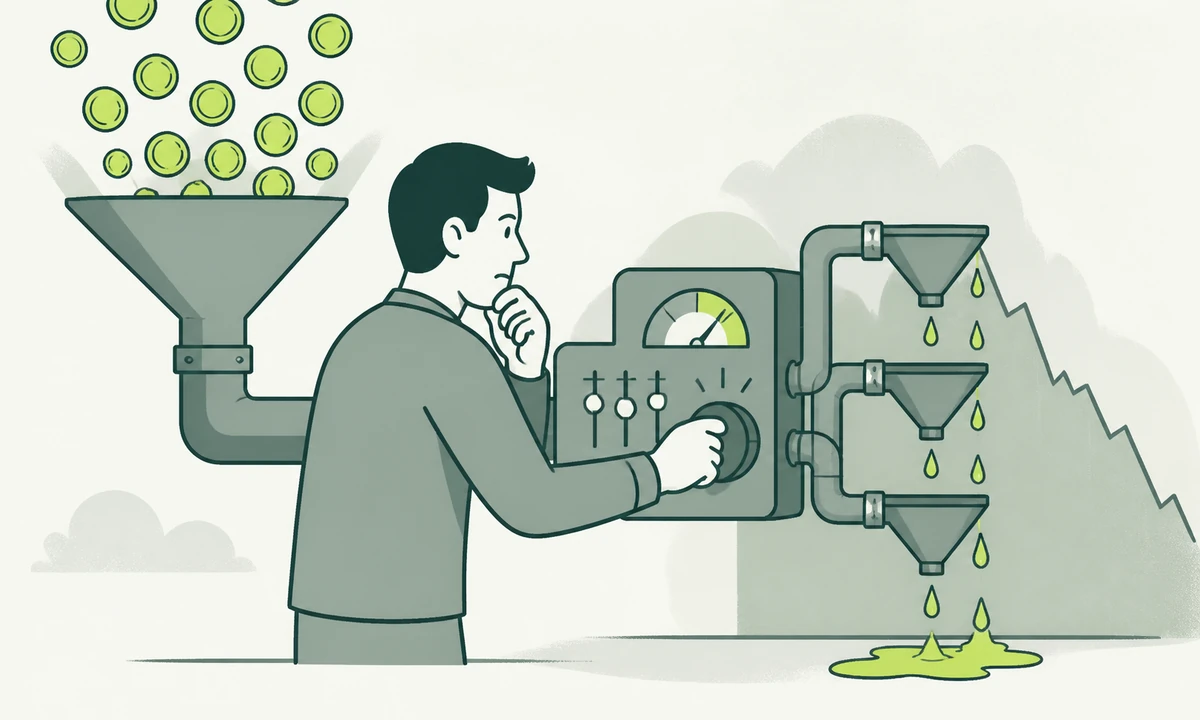
A campaign has been working for months at a modest daily budget. Someone senior asks the reasonable question: what happens if we triple it? Three weeks later spend is up, conversions are up slightly, and cost per acquisition has moved somewhere nobody wants to present. The account manager is asked what broke. Usually nothing broke. The account did exactly what it was told to do.
Here is the claim this piece defends. Extra budget does not buy more of the traffic that was working. It buys the next impression down the list, then the one after that. Demand for any specific intent is close to a fixed quantity in any given week, and once you are taking most of it, more money can only reach people who wanted something slightly different, then quite different, then not relevant at all.
Which means that scaling paid search is a demand problem wearing a bidding costume. There are three places the ceiling actually sits: the account, the offer, and the page. Teams investigate them in that order, which is backwards.
We run this diagnosis often enough on performance marketing work that the order has become a habit: page, offer, account. Most of the recoverable money is in the first two, and the third is usually the part that has already been rebuilt twice.
Search demand is a quantity, not a market you can create
Paid social manufactures attention. Somebody was not thinking about your category, and an ad made them think about it for six seconds. Paid search does the opposite job. It stands in front of demand that already exists and takes a share of it. That difference is the entire reason scaling behaves badly here and behaves reasonably there.
In any given week, the number of people typing a query that genuinely matches what you sell is roughly fixed. You can take a larger share of those impressions. You cannot make more of them appear by raising a budget cap. Once impression share on the terms that convert is already high, additional money has nowhere sensible to go, so the platform finds it somewhere less sensible.
- Impression share you were losing. The only kind that is genuinely more of what already worked.
- A higher average position on the same terms. More money per click for a click you were often winning anyway, further down the page.
- Query sets you had not been matching. This is where intent starts to slide, and it slides quietly.
- New geographies, hours and devices. A real lever, and a slow one, with its own conversion economics.
- Other surfaces entirely. Shopping inventory, partner networks, display expansion, whatever the recommendations screen is pushing this quarter.
Only the first of those is more of the thing that was working. Everything below it is a different product carrying the same reporting label. When an account "stops working" at a higher budget, what has usually happened is that the mix moved down that list while the campaign names stayed the same.
The head-to-tail shift, in slow motion
This shift is rarely a decision anyone made. It is an accumulation of small, individually defensible changes. Match types widen because a recommendation promised more conversions. A campaign is duplicated into a broader theme. Automated bidding is handed a bigger budget and a target it can only hit by finding cheaper clicks. Each of those is arguable on its own. Together, over about six weeks, they walk the account down the intent ladder.
What you were buying
At the start you were buying people who had already decided three things: that they have the problem, that a supplier can fix it, and that they want to act now. That searcher flatters everything around them. The copy looks sharp, the page looks well built, the follow-up looks disciplined, the sales team looks brilliant. It is very easy to mistake that person for evidence that the machine works.
What you start buying
Further down, you buy people who are still describing a symptom. They are not worse people. They are earlier, and earlier traffic needs a different page, a different next step and a different definition of success. Sending them to the same demo request form and then reporting a rising cost per acquisition is a measurement error dressed up as a performance problem. A page that answers the query they actually typed will beat a page that ignores it. But even a good version of that page will not convert like the bottom of the funnel, and it should never be asked to.
| Query layer | What the searcher has already decided | What extra budget buys here |
|---|---|---|
| Branded and near-branded | Which supplier they want; they are confirming a detail | Very little. Those impressions were mostly yours already |
| High-intent non-branded | That they have the problem and want it solved now | Genuine incremental volume, until impression share runs out |
| Category and comparison | That the category might be relevant to them | Research traffic that converts later, or never, on the same form |
| Problem-shaped and informational | Nothing yet. They are describing a symptom | Clicks that only mean something with a nurture path behind them |
| Broad and adjacent matches | Nothing relevant to you at all | Waste, presented in the interface as reach |
Read that table as a map of where the next unit of budget lands. The account has not degraded. It has been pushed into a part of the query set where the same money buys a different kind of person, and the blended number is the only place that shows up.
Audience exhaustion, and why frequency reports flatter you
The second ceiling is made of people rather than queries. Remarketing pools, customer lists and in-market segments all have a size, and that size was set by traffic you earned earlier. Spend more against a fixed pool and you buy repetition rather than reach. The report shows impressions climbing, and climbing impressions look like growth.
Repetition is not worthless. It is simply worth less each time, and it degrades in a particular way: the people most likely to convert convert early, so what remains is progressively made of people who have already declined. The pool is selecting against you for weeks before frequency looks uncomfortable in any dashboard.
This is the mechanism behind the complaint we hear most often, which is that the creative stopped working. Occasionally that is true. More often the creative is fine and the audience is finished.
Before you conclude anything from a month-on-month comparison, check whether demand itself moved. Category search volume has a shape, and scaling into a seasonal trough draws exactly the same chart as an account that has broken. One of those is fixed by patience and the other is not, so establish which you are looking at before anybody rebuilds a campaign.
The offer ceiling
Suppose the account is clean and the audience is fresh. There is still a ceiling, and it is the one teams find hardest to accept, because it is not in the advertising at all. The offer sets the maximum conversion rate the traffic can reach. Bidding only decides how efficiently you approach it.
By offer we do not mean the product. We mean the price of the next step: what the visitor hands over, how much of their time it costs, how reversible it feels, and how well it matches where they are in the decision. "Book a call with our team" is an expensive ask for somebody who typed a symptom into a search bar. "See what this involves for a team your size" is cheap. Same product, different offer, and the second one has a far higher ceiling.
When performance flattens at a higher budget, the offer is the first place we look, because it is the only lever that moves the ceiling instead of the efficiency. The long version of this argument is elsewhere: the offer is the campaign, and creative keeps getting blamed for a problem it was never able to solve.
Budget changes how many people see the offer. Only the offer changes how many of them say yes.
Account, offer, or page: a diagnostic you can run this week
Here is the sequence we use. It is ordered so the cheapest questions come first, and it usually terminates before step five.
- Segment by query, not by campaign. Split the last full period into branded, high-intent non-branded, and everything else. If cost per acquisition held inside each segment and only the blended figure moved, there is no performance problem. There is a mix change, and the fix is allocation.
- Check impression share on the terms that convert. If it was already high before the budget rose, there was never room to scale on those terms, and the extra money was always going to land somewhere softer.
- Compare new-visitor conversion rate with returning. If the new-visitor rate held and the blend fell, you are looking at audience exhaustion rather than traffic quality. Those two have different fixes and very different timelines.
- Read the top five landing pages as the searcher. Does the page answer the query in the first screen, or introduce the company first? Time how long it takes to become useful, and be honest about the number.
- Ask what the visitor must give up to take the next step. If the only conversion action on the page is the most expensive one, the ceiling is the offer, and no bidding change will move it.
When the answer is the page
This is the most common outcome and the most fixable. Paid traffic lands on a page written for a warmer audience, or a page that answers an adjacent question, or a page that takes too long to become useful. Render speed matters here in a way that is easy to underrate, because a click you have already paid for and then lost to a slow page is the most expensive waste available. Conversion optimisation on the five pages taking the largest share of spend usually returns more than a month of bid tuning.
There is also the case where the page is good and the visitor simply has a question it does not cover: sizing, eligibility, timelines, whether you work in their sector at all. A lightweight assistant that answers from the site’s own content, and carries the contact and conversion actions in the same place, is a reasonable response to that, and Flidu is built around exactly that pattern. It is not a substitute for a page that answers the query. It is a catch for the question the page did not anticipate.
Whatever you change, change one thing at a time and then prove the change actually moved something. Page work has a bad habit of shipping in batches and then being credited to whichever change the loudest person in the room preferred.
When the answer is the offer
Harder, slower, worth more. Adding a genuinely lighter next step beside the heavy one usually raises the total, because you stop asking every visitor to be ready today. The risk is real and deserves naming: a lighter offer produces more leads at a lower average quality, and if the follow-up is not built for that, you have simply moved the bottleneck into the sales team and made them unhappy with you.
When the answer really is the account
Sometimes it is, and this is the concession the piece owes. Mismatched match types. A conversion action counting form views instead of submissions. A bidding strategy optimising toward a signal that stopped firing after a template change. Geographic settings that quietly include the whole world. These are common, they are real, and several of them are fixable in an afternoon. What they are not is the explanation for every plateau, which is precisely how they get used.
What scaling honestly looks like
If demand is fixed and you want to spend more, there are four options and only four. Widen the query set and accept different economics for the new part. Improve the conversion rate so the same traffic produces more. Extend the value of a customer so you can afford to pay more for one. Or add a surface that creates demand instead of harvesting it.
Most teams try the first, skip the other three, and conclude that paid search has become expensive.
The second and third are where the durable gains sit. If the earlier traffic you are now buying needs weeks and several conversations before it becomes anything, then the campaign does not end at the click. It ends somewhere inside a lifecycle programme, and what that programme contains is a separate discipline. The honest version of it starts by asking how many touches a buyer needs before they reply, and what those touches are supposed to say.
The measurement that ends the argument
Nearly every dispute about scaled paid search is really a dispute about the metric. Cost per lead falls when you loosen the definition of a lead and rises when you tighten it, which makes it useless as a scaling signal at exactly the moment you need one. We have argued at length that cost per lead is a trap. The short version: it measures the top of a process and then gets used to judge the bottom.
What we would report instead is cost per qualified opportunity, broken out by query segment, tracked from the same source, with the segment definitions frozen before the budget changes. That last clause does more work than the metric does.
It also takes time, and the timeframe is worth agreeing before anybody spends anything. Our parent company has written plainly about what ninety days can honestly show, which is a more useful conversation to have before a budget increase than after one.
Write down, in advance, the result that would make you reverse the decision. A budget increase with no stated reversal condition is not a test, it is a commitment, and commitments are what people defend rather than measure.
Where we would start
One week, a plateau, and a budget somebody has already defended in a meeting. Spend it like this. Two days segmenting spend by intent, because that alone settles a surprising number of arguments. Two days on the landing pages taking the largest share of the money. One day writing a lighter offer and getting it approved by whoever has to service it. Account tuning comes last, not because it does not matter, but because it is the part most likely to have been done twice already.
The rule underneath all of it: spend can find demand, but it cannot create it. Once you hold most of the demand that matches your offer, the next honest move is to change the offer, widen what you are willing to match, or accept the ceiling and put the money somewhere it compounds.
And here is the condition where all of this reverses. If the account has never been segmented, if conversions are counting the wrong event, or if a single campaign is quietly eating the budget on branded terms you would have won for nothing, then fix the account first and come back to the argument afterwards. If you are looking at a chart that flattened after an increase and cannot tell which of the three ceilings you hit, tell us what you are running and what changed the week it stopped.
Common questions.
Why does my cost per acquisition rise when I increase the paid search budget?
Because the extra budget reaches lower-intent searches. Demand for any specific intent is close to fixed in a given week, so once you hold most of the impressions on terms that convert, additional money can only buy queries further from your offer. Those visitors are earlier in their decision, need a different page and a lighter next step, and convert at a lower rate on the same form.
How do I know whether the problem is my ads account or my landing page?
Segment spend by query intent first, then compare conversion rates within each segment. If the rate held steady inside every segment and only the blended number moved, the account is behaving and your traffic mix changed. If the rate fell inside a segment whose traffic did not change, look at the page that segment lands on, starting with how fast it becomes useful and whether it answers the query directly.
What is impression share, and why does it limit scaling?
Impression share is the proportion of available impressions your ads actually received for a set of queries. It matters when scaling because it puts a number on how much room is left. If you already hold most of the impressions on your converting terms, there is nothing more to buy there, so a budget increase must reach different queries, different audiences or different surfaces instead.
Is audience exhaustion the same thing as creative fatigue?
No. Creative fatigue means the same people have seen an ad often enough to stop noticing it. Audience exhaustion means the pool itself has been depleted of the people most likely to convert, because they converted early. New creative helps the first problem and does very little for the second, so check pool size and new-visitor conversion rate before commissioning a rebuild of the ads.
Should I use a lower-commitment offer to scale paid search?
Adding a lighter next step usually raises total conversions, but only if the follow-up is built for it. A lower-commitment offer produces more leads at a lower average quality, which moves the bottleneck into sales rather than removing it. Add the lighter option beside the heavier one instead of replacing it, decide who handles the extra volume, and measure at the qualified stage.
How long should a paid search budget increase run before I judge it?
Long enough for your sales cycle to complete at least once, and no shorter. Judging an increase on form fills alone will flatter it, because the earlier traffic you are now buying converts to a form more readily than it converts to revenue. Agree the window, the metric definitions and the reversal condition before spend changes, then leave the settings alone inside that window.
Facing this in your
own business?
Tell us where you’re headed — we’ll map the shortest honest route.