

How Many Touches Before a B2B Buyer Replies, and What Should They Say?
There is no honest number. There is a structure: every touch carries information the last one did not, the ask never grows, and the sequence stops before persistence starts costing you the brand.
On This Page
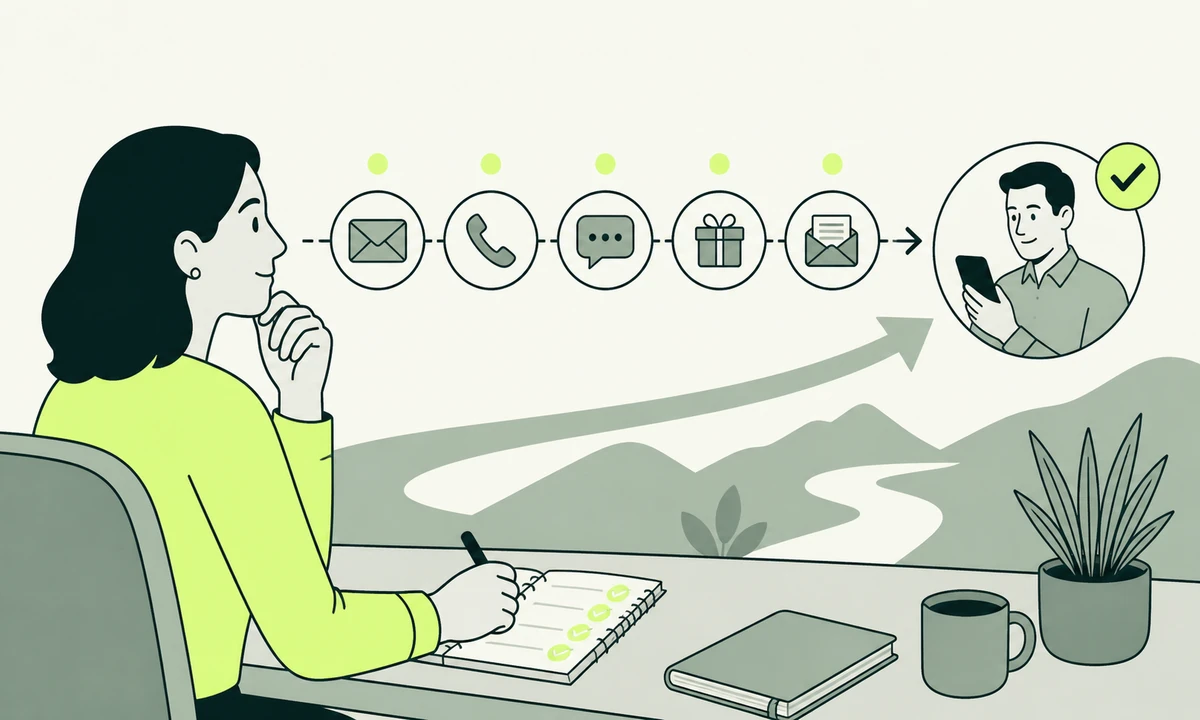
Someone asks how many follow-ups they should send before giving up, and someone else answers seven. Nobody in the room can say where seven came from. Nobody asks what the seven messages are supposed to contain, which is the only part of the question that has a defensible answer.
A B2B outreach cadence is usually built as a countdown. Seven attempts, then the contact goes back in the pool and the cycle starts again next quarter. Built that way, the messages become interchangeable by the third one, because the only variable left is the phrasing of a request that has already been made and already been declined by silence. The buyer works this out well before the sender does.
The position we will defend: stop counting sends and start auditing what each one adds. A sequence in which every touch carries something the previous one did not can run longer than most teams expect and cost nothing. A sequence that repeats one ask in six voices has already done its damage by message three, and the damage is not the deal you lost. It is a name arriving in a market attached to a feeling.
Why the magic number fails
Any number you have been given is an average taken across situations with nothing in common. Contract size moves it. Whether the buyer already understands the category moves it. Whether a trigger event exists moves it more than either, because a buyer with a live problem answers the first competent message they receive, and a buyer without one will not answer the twelfth.
Then there is the arithmetic. Your number counts what you sent. The buyer counts something else entirely, and the gap between those two figures is where most sequences quietly go wrong.
What the buyer is counting
Three emails, a connection request and a voicemail in the same week are not five touches from where the buyer sits. They are one week of being pursued by a company they never agreed to talk to. Compress the same five into two days and they become a single incident. Spread them across four months and they are five separate opportunities to be useful.
- A profile view does not register. It happened in a tab the buyer closed. Automation that logs it as a touch is counting its own activity and calling it a relationship.
- An open is not a read. It is a pixel firing, sometimes fired by a security scanner before any human sees the subject line. Treat it as weather rather than as interest.
- A message to their colleague registers twice. It arrives once as your message and once as the awkwardness of a colleague forwarding it with "do you know these people?" attached.
- A call at a bad hour lasts a week. The interruption is remembered long after the content of it is forgotten, and it colours everything that arrives afterwards.
A working definition of a touch
A touch is any moment where the buyer has to spend attention deciding whether you matter. That definition is deliberately unkind to reporting, because it excludes most of what a dashboard calls engagement and includes several things nobody logs anywhere.
It excludes the impression they scrolled past and the automated view of their profile. It includes the moment a colleague asks whether they have heard of you, the moment your name appears in a newsletter they trust, and the moment they land on a pricing page at eleven at night and leave without finding what they came for. Two of those three are things you can influence, and neither of them is in your sequence.
Each touch adds information, or it is noise
Here is the whole method, and it replaces the number: every touch must carry something the previous touch did not, and the ask must never grow. If you cannot say what is new in the message you are about to send, do not send it. Wait until you can. That single test does more for reply rates than any subject-line experiment, and it has the useful side effect of ending sequences that should never have started.
The test is close to the one search engines apply to published pages: was this made for a person, or made to satisfy a system? Google sets that standard out in its guidance on creating helpful, people-first content, and it travels intact from a landing page into an inbox. Something written to fill slot four in a workflow reads exactly like what it is.
- New evidence. Something about their situation you did not have last time: a job posting, a new integration on their site, a shift in what they publish. Evidence is the line between research and mail merge.
- New specificity. A narrower version of the claim. "We help companies grow" becomes "sites that publish weekly and still lose search traffic after a redesign usually have three redirects wrong". One of those invites a correction. The other invites nothing.
- New format. The same idea in a shape that costs less to consume. Four lines instead of a page. A two-minute recording instead of a meeting request. Format is information about how much you respect their time.
The follow-up that only repeats the ask
"Just following up." "Bumping this to the top of your inbox." "Did you get a chance to look at my note?" Every one of these adds nothing and costs a decision. Worse, each raises the price of replying, because the buyer now has to acknowledge that they ignored you once already. Politeness makes silence the cheaper option, and your sequence manufactured that.
Writing touches that carry information is research work, and research work needs an owner with time for it. That is the practical reason the agency, freelancer or first marketer question keeps surfacing here. A sequence is cheap to automate and expensive to write well, so the resourcing decision is really a decision about which of those two things you are buying. The same tension runs through lifecycle marketing, where messages are triggered rather than typed but still have to be worth receiving.
A shape that holds, in six moves
Not a schedule. A set of roles, each of which has to earn its place, in an order that makes sense to the person receiving them rather than to the person sending them.
- The reason you are writing. Something specific and verifiable about them, in the first line, followed by a small ask. Not a meeting. A question they can answer in one sentence while walking.
- The evidence. One artefact worth their time whether or not they ever reply: a teardown, a checklist, a note on the specific failure you believe they have. This is the touch that decides whether you are worth listening to.
- The narrowing. State the version of the problem you think they have and invite a correction. Being told you are wrong is a reply, and a reply is what you asked for.
- The change of channel. Same idea, different medium, shorter than the email was. A channel change is permitted to repeat the thought. It is not permitted to repeat the request.
- The useful goodbye. Say you will stop, leave the artefact behind, and mean it. This message draws more replies than the four before it combined, which tells you something uncomfortable about the four.
- The re-entry, months later, on a trigger. They hired for the role. They shipped the thing. They published a position that contradicts the one you addressed. A trigger makes a sixth touch feel like a first one.
Notice what the list does not contain: a day count. Notice also that the ask is the same size in move one and move six. Escalating the ask as the silence lengthens is the most common structural error in outreach, and it is exactly backwards. Silence is information. It says the current ask is too large, so the right response is to make it smaller.
Mixing channels without multiplying the ask
Multichannel outreach is sold as coverage and delivered as volume. The rule that keeps it honest is narrow: a channel exists to change the cost of paying attention, never to place the same request somewhere the buyer cannot delete it as easily.
| Channel | Where it earns its place | What it says when it is the whole sequence |
|---|---|---|
| Anything needing a link, a document or a record both sides can find later | You have one motion and no judgement about when it fits | |
| Social message | A short question to someone who has just published a view worth questioning | You are working a list, and they are on it |
| Voice call | A live answer to something that would take four emails to resolve | Urgency you invented is now their scheduling problem |
| Paid retargeting | Keeping a name present without asking for anything at all | Being followed, which is a brand impression too |
| Published work | Being findable at the moment the need actually appears | Nothing, which is why it is the channel that never annoys anyone |
| A warm introduction | Borrowing trust from someone who already spent it on you | A network you are drawing down faster than you top it up |
One qualifier worth stating plainly: the bottom two rows do not scale on demand. You cannot decide on a Monday to be findable, and you cannot manufacture an introduction because the quarter is short. That is an argument for building both long before the sequence needs them, not an argument against running a sequence.
Timing that is not a calendar
Fixed intervals are a confession that you have no idea what is happening on the other side. Two days, two days, three days, seven days is not a cadence. It is a metronome, and a metronome is what automated systems sound like from the receiving end.
Widen the gaps as you go. The first two touches can sit close together because they still read as one conversation. Every gap after that should be longer than the one before it, until the spacing becomes occasional presence rather than a campaign. And whenever a trigger appears, it overrides the schedule completely, because a trigger is the buyer telling you the timing without meaning to.
Cold outreach is not equally lawful everywhere, and "everyone does it" is not a position. Where you process personal data about contacts in the EU, that sits under the General Data Protection Regulation, and other jurisdictions set their own rules on consent, sender disclosure and record-keeping. Take advice that covers the markets you actually sell into, honour every opt-out immediately, and keep the record of where each contact came from. None of this is legal advice, and a sequence running on data you cannot account for is a liability wearing a pipeline costume.
What happens between the touches
Between touch two and touch three, the interested ones look you up. They read a page, check whether you have written anything about the problem, and decide privately whether to take you seriously. Almost none of that is under the control of the person sending the emails, which is why an outreach programme with no content calendar behind it is asking its messages to carry weight they were never built for.
That same visit is where a good deal of quiet interest dies. Someone arrives with one question at an hour when nobody is answering, fails to find it in three clicks, and leaves. An assistant inside the site is one way to close the gap: Flidu answers from a site’s own content and carries contact and conversion actions in the same widget, so a question gets an answer instead of a form. And when someone does complete the form, what happens next matters as much as the sequence did, which our parent company has written about in a form is a triage instrument.
Paid media has a role in the gap too, though a narrower one than it is usually sold with. Retargeting that does not follow people around keeps a name present at a frequency that does not read as surveillance, and it asks for nothing, which is exactly why it works alongside a sequence rather than inside one. Treat it as the quietest part of performance marketing rather than as another touch to count.
Where persistence turns into a brand cost
There is a point at which one more touch stops costing you a reply and starts costing you the next three years. It is rarely dramatic. Nobody writes back to tell you. The signals appear somewhere other than the sequence report, which is why the sequence report keeps saying everything is fine.
Watch for three of them. Your messages start being screenshotted and passed around, which turns a sales problem into a distribution problem you did not want. Your sending reputation slips, so the mail people did want stops arriving. And your name begins to be introduced by other people with a qualifier attached. That last one is the expensive signal, because the qualifier outlives the campaign, the person who ran it, and usually the tool it ran on.
A sequence is not a countdown to a yes. It is a series of chances to be useful enough that someone remembers you when the problem finally arrives.
The honest concession: there are categories where the persistent rep genuinely wins. Long procurement cycles, buyers who cannot act until a budget exists, and markets where every competitor gave up at touch three all reward staying present far longer than this article implies. What they reward is presence, not repetition. The person who wins those deals is the one still adding something at month nine, not the one who sent nine copies of one message and called it discipline.
Measuring it without lying to yourself
Reply rate on its own pushes you toward the behaviour this piece argues against, because the shortest route to more replies is more sends. Pair it with something that captures the cost: negative replies as a share of all replies, opt-outs by touch number, and the position in the sequence where positive replies actually arrive. If nearly all of them land at touch five, touches two to four are doing real work. If none of them do, touch five is a tax you are levying on your own reputation. This is ordinary analytics and measurement work, and it belongs in place before the first send rather than reconstructed afterwards.
Give it enough time to say anything, too. Outreach into a considered purchase produces leading signals long before it produces revenue, and reading the early numbers as though they were final is how sound programmes get cancelled in month two. We have set out what the opening window can and cannot show in what you can honestly measure in ninety days.
Where we would start on Monday
Open the sequence you are running now and write, beside each message, the one thing it adds that the previous message did not. Any message where that column stays blank gets deleted rather than rewritten. Teams doing this for the first time usually delete about half the sequence and find the remaining half performs the same or better, because the deleted messages were the ones producing the opt-outs.
Then set the stopping rule in advance, while nobody is under quota pressure, and write it somewhere the whole team can see. A rule decided in advance survives a bad month. A rule decided during one becomes "one more touch, it cannot hurt", which is the sentence that precedes every reputation problem this channel produces.
And if the honest answer is that you have nothing new to say at touch three, the problem sits upstream of the cadence. It is a positioning problem, or a research problem, or the plain fact that this segment does not have the problem you are describing. None of the three is fixed by sending more. If you want a second read on a sequence that has stopped working, tell us what you are sending and who it is going to.
Common questions.
How many follow-up emails should a B2B sequence contain?
There is no number that transfers between businesses, so use a test instead of a count. A sequence should continue while each message carries information the previous one did not, and stop the moment it cannot. In practice that produces five or six meaningful touches for most teams, spread across months rather than weeks, with the final one closing the loop rather than asking again.
How long should you wait between outreach touches?
Widen the gap each time. The first two messages can sit close together because they still read as one conversation, and every gap after that should be longer than the one before it, until contact feels like occasional presence rather than a campaign. Fixed intervals of two or three days signal automation. A genuine trigger event, such as a relevant hire or launch, overrides the spacing entirely.
Is it better to use email, social messages or calls for B2B outreach?
Use more than one, but change channel to change the cost of paying attention, never to repeat a request the buyer already declined. Email suits anything needing a link or a shared record. A short social message suits a question about something the person just published. A call earns its place only when a live answer saves several emails, which is rarer than most scripts assume.
What should the last message in an outreach sequence say?
Say you are stopping, leave something useful behind, and then actually stop. A closing message that offers the artefact, states plainly that you will not write again, and leaves the door open without conditions tends to draw more replies than several of the messages preceding it. Do not disguise it as a final chance or a deadline, because a manufactured deadline undoes the goodwill it was meant to earn.
Can outreach damage a brand?
Yes, and the damage usually shows up somewhere the sequence report cannot see. The warning signs are messages being screenshotted and shared, sending reputation slipping so that wanted mail stops arriving, and your company name being introduced by other people with a qualifier attached. That last effect outlives the campaign, the person who ran it and the tool it ran on, which is why a stopping rule matters.
How do you know whether a cadence is working before anyone replies?
Read the shape of the responses rather than the volume. Track negative replies as a share of all replies, opt-outs by touch number, and the position in the sequence where positive replies actually arrive. Those three tell you which messages earn attention and which are merely tolerated, well before revenue can say anything useful. Put the tracking in place before the first send, not afterwards.
Is cold outreach lawful for business contacts?
It depends on the jurisdiction you are contacting, so check before the first send rather than after a complaint. Processing personal data about contacts in the EU falls under the General Data Protection Regulation, and several other markets regulate consent, sender disclosure and record-keeping separately. Take advice covering the markets you sell into, honour opt-outs immediately, and keep a record of where every contact came from.
Facing this in your
own business?
Tell us where you’re headed — we’ll map the shortest honest route.