

Free Trial or Freemium: Which One Fits What You Are Selling?
Pick by three facts you already have: how long the product takes to become useful, what a free account costs you to run, and whether the free tier is a demo or a product in its own right.
On This Page
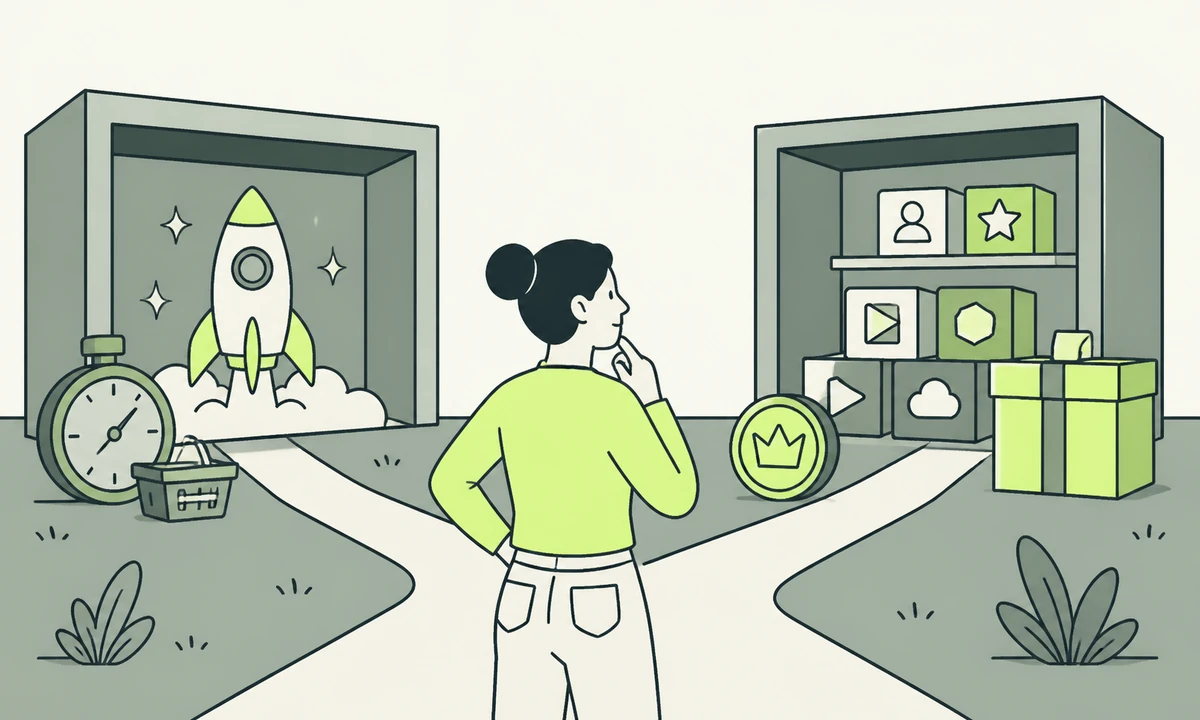
A team asks whether to run a fourteen-day trial or open a free tier, and treats it as a pricing decision. It is not. Both models are a claim about how long your product takes to become useful, and about who is allowed to find that out without paying. Get those two claims right and either model works. Get them wrong and neither does.
The free trial vs freemium argument usually gets settled by whatever the last admired company did, which is how a product with a heavy setup cost ends up with a seven-day clock. Three facts should decide it instead, and you already hold all three: time to value, the marginal cost of a free account, and whether the free tier is a demo or a product. Trial length, feature gating and upgrade prompts are consequences of those three, not inputs to them.
This piece takes a position. Most early software should run a trial. Most products with real per-account infrastructure should not run freemium at all. The reverse trial suits more teams than currently use it. And a fair number of products should offer neither, which is the section everyone skips.
What you are really choosing
Strip the marketing off both models and they are two answers to one question: what does an unpaid person get, and for how long? A trial gives the whole product for a bounded time, so the limit is a clock. A free tier gives part of the product indefinitely, so the limit is the shape of whatever you held back.
That mechanical difference produces every second-order effect people argue about later: support load, how sales gets involved, what the infrastructure bill does in month nine, and how much of the product roadmap is quietly spent maintaining a version nobody pays for. It also changes what your marketing page has to do, which is a separate discipline we cover in building a SaaS landing page that sells the job.
One consequence is worth stating before anything else. A trial is a sales instrument. A free tier is a product you now have to run. The first has an end date and a defined cost. The second has neither, and it will collect users, tickets, storage, edge cases and expectations for as long as your company exists. If you would not staff it, do not ship it.
Time to value sets the clock
Time to value is the interval between a person signing up and that person getting the thing they came for. Not finishing the tour. Not ticking the checklist. The actual outcome: the report exists, the site is live, the invoice went out, the alert fired correctly at three in the morning.
If that interval is short and sits mostly in the user’s own hands, a trial works, because they will reach value inside the window and the window is what makes them decide. If the interval is long because value depends on data accumulating, colleagues joining, or an integration somebody in another department has to approve, the clock runs out before the product has had a chance to be good. A free tier is then the honest option: the product needs patience, and a countdown cannot buy patience.
Measuring it honestly
Measure it from your own instrumentation rather than from a walkthrough you ran yourself, because you know every shortcut and your account already has data in it. The number that matters is how long it takes somebody who has never seen the product, working on their own material, without a call. Track the first real outcome, not the signup, and treat the gap between them as the thing you are trying to shrink. The related failure is measuring the wrong signal entirely, which we argue in churn is a lagging indicator.
Two mechanical things move this number more than any redesign. The first is whether the signup and first-run path stays responsive while the user is actually interacting with it, which is what Interaction to Next Paint measures and what a heavy onboarding wizard tends to fail. The second is whether the first screen after signup tells the person what to do next. That screen is usually blank, usually an afterthought, and usually the reason a trial dies quietly, which is why we wrote empty states are the most neglected screen in your product.
When the clock is long anyway
Some products genuinely cannot deliver value in a week, and pretending otherwise produces a trial that converts nobody and teaches you nothing. There are three usable moves. Seed the new account with realistic sample data so the product is demonstrably alive before the user has done any work. Ship templates that stand in for the configuration a real customer would spend a fortnight on. Or start the clock when setup completes rather than at signup, so the window covers use rather than admin.
The third is unfashionable because it complicates billing logic, and it is the one that works. A trial should measure whether somebody wants the product, not whether they can survive your installation process.
Decide the window after you know time to value, never before. If the product delivers on day two, a long window mostly buys silence and a forgotten reminder email. If setup honestly takes a week, a short window is a rejection letter with extra steps.
What a free account costs you to run
Freemium is a standing commitment, and standing commitments behave the way every other permanent obligation in a product behaves: they accumulate quietly and get paid forever. We have made the general version of this argument in the standing cost of every feature you ship. A free tier is that argument with a signup form attached to it. Before opening one, price what a single free account consumes.
- Infrastructure that runs whether or not anyone logs in. Stored files, retained history, scheduled jobs, background syncs and anything doing inference on a timer.
- Support. Free users file tickets, and they file more of them when the free tier is confusing about where it ends.
- Abuse surface. Anything that publishes, sends or hosts on a free account will be tested by people who are not your customers.
- Roadmap gravity. Every free-tier limit becomes a permanent branch in the code and a permanent question in every design review.
- Attention. Free accounts that look like prospects but are not will absorb sales time unless somebody defines the difference.
If the marginal cost of a free account is close to zero and stays close to zero as the account ages, freemium is affordable and the growth argument is worth hearing. If the cost grows with time because storage accumulates, history is retained, or a job runs on a schedule, you have not built a growth channel. You have built a liability that signs itself up.
Model the free tier at the size it will be in twenty-four months, with retention and storage included, and with nobody deleting anything. If that number frightens you, the answer is not stricter limits later. Retroactively removing free capacity is a public event, and it costs more goodwill than the tier ever earned.
Is the free tier a demo or a product?
This is the test that settles most freemium designs, and almost nobody applies it before launch. Ask what the free tier is for. There are two honest answers and they lead to different products.
A demo exists to make somebody buy, so it is allowed to be incomplete and it should be time-boxed. A product exists to be used indefinitely by people who will never pay, because their presence is worth something to you: they bring colleagues in, they produce artefacts other people see, or they make the paid tier more valuable to the people who do pay. If you cannot name which of those three you are buying, you are running a demo and calling it a tier.
The amputation test
Remove the paid features and look hard at what is left. If the remainder is a coherent thing a person could use every week without irritation, you have a product. If it is the paid product with holes cut in it, you have a demo that never expires, and that is worse than a trial that does, because it spends months teaching people your software is disappointing. Trials fail closed. Bad free tiers fail open, in public, for years.
The ceiling test
A free tier needs a ceiling that a successful user reaches by succeeding, not a wall they hit by trying. Usage volumes, collaborator counts and retention windows work well, because growth itself causes the upgrade and the upgrade feels earned. Feature gating works badly whenever the gated feature is the one that makes the product make sense, and every team is tempted to gate exactly that feature.
Drawing that line is easier once you have settled what you are actually selling. Our parent company has written the underlying distinction in product, service or feature, and it is worth reading first, because a free tier built on top of something that is really a feature will never hold a ceiling.
Freemium earns its keep when the free artefact is itself distribution. A product like Nichevio assembles mobile-first profile sites from structured widgets, and a profile site is public by design: what the unpaid user makes is seen by people who are not users yet. Where that is true, the free tier is a channel with a cost attached. Where it is not true, it is a cost centre with a story attached.
Free trial vs freemium, side by side
Pricing-page comparisons list what each model gives away. The differences that actually show up once real users arrive are these.
| Concern | Free trial | Freemium |
|---|---|---|
| What the user gets | Everything, for a fixed window | A bounded slice, indefinitely |
| What creates urgency | The expiry date | Reaching a usage ceiling |
| Suits time to value that is | Short and self-service | Long, or dependent on other people |
| Marginal cost tolerance | Bounded by the window | Must stay near zero as accounts age |
| Support load | Concentrated and predictable | Continuous and open-ended |
| Sales fit | Works with assisted selling | Self-serve, or it fights the sales motion |
| Main failure mode | Clock expires before value lands | Free is good enough forever |
| Cost of changing it later | Adjust the window quietly | A public and unpopular event |
The reverse trial, and why we default to it
A reverse trial gives every new account the paid product for a bounded window, then drops it to a free tier instead of a paywall. Teams tend to read that as a compromise between the two models. It is closer to the opposite: it is the only arrangement that answers both questions at once, showing the whole product while attention is at its peak, then keeping a relationship alive after the window closes.
It works because attention is highest in the first session and never that high again. A person who has seen the full product and then settles onto the free tier knows exactly what they gave up, and they upgrade later for a reason they can articulate. A person who never saw it upgrades on faith, which is a much weaker motive.
It fails in two situations, and both are predictable in advance. When the tier below the window is not viable on its own, the downgrade reads as a punishment and people leave loudly rather than quietly. And when the paid product carries genuine per-account cost, a reverse trial hands every signup an infrastructure bill before anyone has qualified them.
Our rule: run one only if you can describe, in a single sentence, what the account looks like the day after the window ends, and that sentence describes something a person would still open. The messages that carry somebody across that transition are lifecycle work, not a footnote on the pricing page, and they are the part most teams write last and send badly.
A trial is a deadline you set for the customer. A free tier is a promise you make to yourself. Only one of them expires.
Who should offer neither
Some products should sell without giving anything away, and saying so out loud is unpopular because self-serve has become the default assumption rather than a decision. These are the cases where we would skip both models.
- Products where every account is expensive to run before it has produced anything useful.
- Products bought by a committee, where the person who signs never touches the software.
- Products whose real value is the service wrapped around them rather than the software itself.
- Products still changing shape weekly, because a free tier freezes a surface area you have not finished designing.
- Products with a small, reachable market, where one conversation converts better than a thousand signups.
For those, the honest alternative is a guided walkthrough on the buyer’s own data, or a paid pilot with a defined end and a written definition of success. Both convert better than a free account nobody opens twice. The page in front of that motion has a different job as well, which is the argument in what a landing page should ask for: the form that starts the right conversation beats the form that harvests the most addresses, every time you measure it past the first month.
How we would decide
Run these in order and stop at the first one that gives you a clear answer. Most teams stop at question two or three.
- Is the marginal cost of a free account near zero, and does it stay there? If not, freemium is off the table however good the growth story sounds. A trial, a pilot, or nothing.
- Can a new user reach real value inside a bounded window, alone? If yes, run a trial and size the window to the work rather than to the calendar.
- Would the free tier survive as a product if every paid feature vanished? If not, do not ship it. A permanently disappointing product is worse advertising than no product.
- Does a free user create something other people see, or bring colleagues in? If yes, freemium is distribution, and it can be worth running at a loss you have actually calculated.
- Can you describe the day after the window closes in one sentence? If you can, run a reverse trial. If you cannot, you are not ready to open anything to anyone.
Here is the condition that reverses all of it. If your product only delivers value once somebody on your team has configured it by hand, no self-serve model will rescue that, and picking between them is displacement activity. Fix the setup path first as product improvement work, then choose. Teams that pick the model first spend a quarter optimising a funnel into a product that cannot receive strangers.
And whichever model you choose, write down what would make you abandon it. A trial that nobody finishes is data. A free tier with a healthy population and no upgrades is also data, and it is the kind teams reinterpret for two years rather than act on. If you are sequencing this alongside a product launch and want a second opinion on where the line should sit, tell us what you are selling and who is meant to be buying it.
Common questions.
What is the difference between a free trial and freemium?
A free trial gives someone the full product for a limited period, so the constraint is time. Freemium gives a limited version of the product with no end date, so the constraint is capability or usage. A trial is designed to produce a decision by a deadline. A free tier is designed to be used indefinitely by people who may never pay, which makes it an ongoing product commitment rather than a campaign.
How long should a free trial last?
Long enough for a new user to reach the first real outcome on their own data, and no longer. Measure how long that takes for someone who has never seen the product, then set the window slightly above it. Extending a short window is easy and generous. Shortening a long one later feels like a takeaway, and long windows mostly buy silence rather than evaluation.
What is a reverse trial?
A reverse trial gives every new account the paid product for a bounded period, then moves the account down to a free tier instead of shutting it off. It shows the full product while attention is highest, then keeps the relationship alive afterwards. It only works when the free tier underneath is genuinely usable on its own, and when the paid features do not carry heavy per-account running costs.
When is freemium a bad idea?
Freemium is a bad idea when each free account costs real money to run, when that cost grows as the account ages, or when the free version is simply the paid product with features removed. It also fights an assisted sales motion, because free users arrive in volume and rarely match the buyer profile. In those cases a trial or a paid pilot is the cheaper instrument.
Does a free tier hurt conversion to paid?
It hurts conversion when the ceiling is drawn in the wrong place. A free tier converts well when users hit its limits by succeeding, through volume, collaborators or retained history. It converts badly when the limit is a feature that makes the product coherent, because users either resent the gate or settle permanently below it. The ceiling design matters more than the price above it.
Should an early-stage product offer anything free at all?
Not always. A product still changing shape weekly should usually avoid a free tier, because the tier freezes a surface area that is not finished. Guided walkthroughs on the buyer’s own data, or a paid pilot with a written definition of success, produce sharper feedback and fewer accounts to support. Free access is a distribution decision, and distribution only helps once the product can receive strangers.
Facing this in your
own business?
Tell us where you’re headed — we’ll map the shortest honest route.