

Automation That Removes a Handoff, Not Just Adds a Dashboard
The seam worth automating is a handoff: the moment work stops with one person or system and waits for the next. Everything else adds a screen somebody now has to remember to check.
On This Page
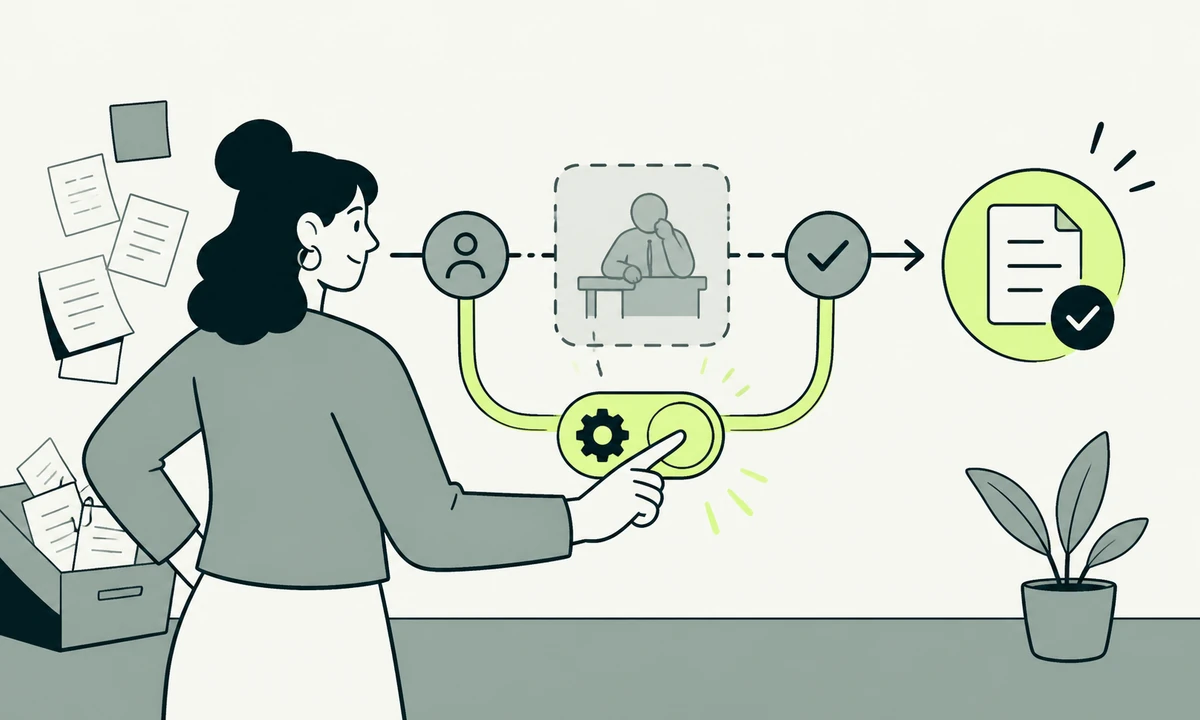
A team spends six weeks building an operations dashboard. It is accurate, it refreshes hourly, and three months later exactly two people open it: the person who asked for it and the person who built it. Nothing about how work moves through the company has changed. The dashboard reports the delay. It does not remove it.
That is the failure this piece is about. Most process automation projects add a surface (a dashboard, a digest, an alert channel) and leave every handoff precisely where it was. A surface is work. Somebody now has to open it, read it, interpret it, and then go and do the thing they were already doing.
So the test we apply is deliberately narrow: does this remove a handoff? If the answer is no, what you have built is reporting, and reporting is a different budget with a different justification. Reporting is worth buying. It simply is not automation, and calling it automation is how a company ends up with a dozen integrations and the same cycle time it had last year.
A handoff is a specific thing
A handoff is the moment work stops belonging to one party and starts belonging to another. It has three properties, and all three must be present before the word applies: something is finished, something is waiting, and somebody has to notice before anything moves again.
That third property is where the time goes. In most small companies the hours are not lost doing the work. They are lost in the gap between finished and noticed: the enquiry that arrived at nine and was assigned at four, the draft that sat in a folder because the reviewer was never told it existed, the invoice waiting on a number somebody had to go and look up.
Three kinds, in order of value
Person to person is the most valuable and the hardest, because the wait is social rather than technical and no integration removes an approval nobody has agreed to give. Person to system is next, and it holds most of the achievable wins: the retyping, the copying between tools, the status somebody updates by hand. System to system is the easiest to build and the least interesting, because if two systems are already talking, nobody was waiting there in the first place.
Why a dashboard usually adds work
A dashboard converts a push into a pull. Work that used to arrive in front of somebody now has to be fetched by somebody. That is a real change and it runs in the wrong direction, because fetching depends on a habit, and habits decay quietly under pressure.
There is a second problem. Dashboards get consulted when somebody already suspects a problem, so they confirm what a worried person suspected and stay closed the rest of the time. The alternative is not a better dashboard. It is a message that arrives where the work already happens, carrying enough context for the next action, addressed to a named person rather than to a channel. A good deal of what gets sold as automation would be more useful as a well-written notification with a link in it.
A dashboard relocates the noticing. It does not remove it, and the day somebody forgets to look is the day it would have mattered.
Map the seams before automating anything
This exercise takes an afternoon and it consistently changes what a team builds first. It needs no tooling, no consultant and no process notation. A whiteboard and the last few weeks of real work will do.
- List the last twenty things the team finished. Real items with names attached, not process categories. Categories describe how you think work happens; the list shows how it actually did.
- For each one, write down where it changed hands. Most items change hands more often than anyone remembers. Record every point, including the ones that feel too small to count.
- Mark the wait at each point. Not the effort, the wait. An hour of work that took four days to start is a four-day problem and a one-hour task, and only one of those numbers is worth attacking.
- Mark whether the handoff carries a decision. A decision means somebody weighed something. Transport means somebody moved something. Transport is automatable today; decisions mostly are not, and pretending otherwise is where these projects lose trust.
- Rank by wait multiplied by frequency. A two-day wait that happens twice a year is an anecdote. A twenty-minute wait that happens forty times a week is the thing to fix.
- Build the top one, and only the top one. Then rerun the map. Removing one seam usually moves the bottleneck somewhere nobody predicted, and the second-ranked item is frequently no longer worth doing at all.
Run it with the people doing the work rather than with their manager, and record what actually happened rather than what was supposed to. Managers describe the process as designed; the people inside it describe the workarounds, and the workarounds are the map. Expect at least one seam that exists purely because two tools cannot see each other, and somebody has been bridging them by hand for a year without mentioning it, on the reasonable grounds that nobody ever asked.
What the map tends to show
Three findings recur. The largest wait is usually right at the start, between a request arriving and anybody owning it. The most automatable step is usually re-entry of data that already exists elsewhere. And the step everybody wanted to automate at the outset is normally a decision, which is exactly why it felt slow: it was slow because it required thought. That pattern holds closely enough that we now open every automation engagement by asking for the map rather than the wish list.
Which seams pay, and which do not
The same seam is worth automating in one company and destructive in another, and the difference is almost always whether the rule underneath it holds still.
| The seam | What waits there | Automate when | Leave it alone when |
|---|---|---|---|
| Enquiry to owner | A request sits unassigned | Routing rules are stable | Every request needs judgement |
| Draft to reviewer | Work waits to be read | The check is mechanical | The check is editorial |
| Signup to first use | A new user waits on setup | Setup is deterministic | Setup depends on a conversation |
| System to system | Data is retyped by hand | Both schemas are stable | One side changes weekly |
| Numbers to decision | A question waits for assembly | The question is fixed | The question changes monthly |
| Condition to responder | Nobody knows yet | The condition is unambiguous | It fires on noise |
The first row deserves the hardest look, because that is where the clock starts. A visitor with a question at eleven at night is a handoff waiting for office hours, and the usual fix is a widget that answers from what the site already says and hands over cleanly when it cannot. That is the shape of a tool like Flidu: website-informed answers alongside contact and conversion actions in one place. It only removes a handoff if the escalation path is real, and if visitors know they are not talking to a person from the first message onward.
Two seams, worked through
Take the enquiry seam in the version we meet most often. A form posts into a shared inbox. Somebody reads that inbox when they get a moment, decides who should handle it, and forwards it on. The handling takes fifteen minutes; the wait before the handling starts eats most of a working day. The automation that removes this seam is unglamorous: classify the enquiry against a small set of stable categories, assign an owner, acknowledge the sender, and deliver the whole thing into the tool that owner already has open. No dashboard, nothing to remember to check. If the classification is wrong the owner reassigns it in one action, and that action is also the evidence that improves the rule.
Now take a seam that looks identical and is not. A proposal needs pricing approval from a director, and the wait is two days. Every instinct says to build a workflow tool with statuses and reminders. The tool gets built, and the wait stays at two days, because the director was never waiting on a notification. They were waiting until they had time to think, or waiting for a number the proposal did not contain. The fix is not software: it is agreeing what a proposal must include before it can be sent for approval, at which point approving takes four minutes. Teams routinely spend a quarter automating around that distinction rather than an afternoon settling it.
The usual way one of these projects dies is not failure, it is refusal. If the automation delivers work somewhere people do not already look, or in a shape that has to be reformatted before it is usable, they will quietly keep doing it the old way and nobody will mention it. Ship into the tool the team already has open, or expect to be routed around politely.
What should stay with a person
Some seams keep their human, and not out of sentiment. Automating them removes the only step where a mistake was ever going to be caught.
- Anything irreversible. Sending, publishing, refunding, deleting, charging. Automate everything up to the button and let a person press it. The preparation was the slow part anyway.
- Anything with a rule that changes quarterly. An automation encodes a rule at a moment in time, then keeps applying it long after the meeting where the rule changed.
- Anything that is the relationship. The first reply to a serious enquiry, an apology, a renegotiation. Speed is not the value being delivered in those moments.
- Anything nobody checks afterwards. If a step produces output no one will ever read, automating it means errors accumulate quietly until something downstream fails in a way nobody can trace back.
- Anything you cannot yet describe precisely. If two people on the team describe a step differently, the disagreement is the work. Automating it only makes one version official without anybody having decided.
The reviewing step deserves particular defence, because it is the first thing an efficiency drive deletes and the last thing anyone misses until it is gone. Our parent company argues that case directly in the reviewer’s pass. The workable compromise is to automate the gathering and keep the judgement: the reviewer opens something already assembled and already checked for mechanical faults, and spends their attention on the part that genuinely needed a person. It is the same pattern we recommend for lifecycle and campaign automation, where the assembly is cheap and the wording is not.
Every automation has a standing cost
An automation is not a purchase, it is a dependency. It holds credentials, it assumes a schema, it runs on a schedule, and it fails in ways nobody sees because success is silent by design. Before building one, price the year: monitoring, the people who need to know it exists, and the work required when an upstream tool changes its API. This is the same arithmetic as the cost of maintaining what you built, applied to something that runs whether anybody is watching or not.
Two disciplines make that cost bearable. Give every automation an owner by name, so there is somebody to ask when it starts behaving oddly. And give it its own credentials with the narrowest access that lets it work, reviewed on the same schedule as any staff account, because a long-lived token belonging to a script nobody remembers is precisely the thing that turns a small incident into a large one.
There is a retirement question too, and almost nobody asks it. Automations outlive the process that justified them: the campaign ends, the team reorganises, the tool is replaced, and the little job keeps running against a form nobody fills in any more. Put a review date on each one when you build it. If nobody can say what it did in the last quarter, switch it off and see who notices. Usually the answer is nobody, and you have just removed a credential, a schedule and a thing that could break.
A scheduled job that has stopped running looks identical to a scheduled job with nothing to do. Every automation needs a heartbeat: a record that it ran, what it touched, and what it decided. Build that on day one, because retrofitting it means reconstructing weeks of behaviour from guesses. The rule applies twice over when an AI experiment becomes a system, where the output stays plausible enough that failure is even harder to see.
Where we would start
Run the map. Pick the seam with the highest wait multiplied by frequency where the underlying rule is stable and the step is transport rather than judgement. Build the smallest thing that removes it, ship it, and rerun the map before building anything else. For a team under about ten people, that is usually enough to make the safe-to-automate question answerable without writing a strategy document first.
Here is the concession. Some dashboards genuinely earn their keep, and the honest exception is a number that changes a decision on a known cadence: the weekly figure that determines what gets built next, the monthly one that sets spend. That is not automation and should not be defended as automation, but it is a legitimate purchase, and it is a different thing entirely from the twelve panels nobody has opened since the demo.
The rule to carry away is short. If nothing waits at a seam, automating it saves nothing worth measuring. If something waits and a person is deciding, automate the preparation and leave the decision alone. If something waits and nobody is deciding, that is your first project. If you want a second view on a workflow before committing engineering time to it, describe the seam that hurts most and what is sitting waiting there today.
Common questions.
What should a small business automate first?
Start with the seam where work waits longest and most often, which is usually the point where a request arrives and nobody yet owns it. Assignment, acknowledgement and routing are mechanical, happen constantly, and rarely require judgement. Data re-entry between two tools is the next candidate. Leave anything irreversible, anything carrying a relationship, and anything whose rules change every quarter with a person.
How do I know whether a process is worth automating?
Measure the waiting time rather than the working time. A task that takes ten minutes but sits untouched for two days is a waiting problem, and automation only helps if it removes that wait. Multiply the wait by how often it occurs, then check whether the underlying rule is stable enough to encode. If the rule changes every few months, maintenance will outweigh the saving.
Why do automation projects fail to save time?
They usually automate a task instead of removing a handoff. Building a dashboard, a report or an alert channel adds a surface someone must now check, so the noticing moves rather than disappearing. The waiting stays exactly where it was, and the team has a new habit to maintain. Time is only recovered when a step that previously required a person no longer requires one.
What is a human in the loop step?
A human in the loop step is a point where automated work pauses for a person to approve, correct or reject it before continuing. The pattern preserves judgement while removing preparation, so the reviewer opens something already assembled and mechanically checked. It suits irreversible actions such as sending, publishing or refunding, and any step where an undetected error would travel a long way downstream.
How much does an automation cost to run each year?
Costs are ongoing rather than one-off, so budget for them from the start. An automation holds credentials that need rotating, assumes data structures that change, and breaks when an upstream tool updates its interface. Add monitoring so a silent failure becomes visible, plus a named owner who knows the automation exists. A rough guide is to treat the build as the smaller half of the total.
Should AI be used to automate a decision?
Use AI for preparation rather than for the decision itself in most business processes. Summarising, classifying, drafting and extracting are reversible steps a person can check quickly. Handing over the decision requires an evaluation set, a record of what the system chose and why, and an agreed way of catching mistakes, which is considerably more work than the initial experiment suggests.
Facing this in your
own business?
Tell us where you’re headed — we’ll map the shortest honest route.